From the Party Line to the Agent
Whose number is it, and whose agent? What a 1992 scenario study says about agents in 2026
When I was growing up, our family had a party line. One telephone line was shared by several households. You listened for your ring, and when you picked up, a neighbour might already be on it.
The number belonged to the house, and sometimes to several houses at once.
The number belonged to the car
By 1992 the number had started to move. While at Gemini Consulting, I worked on future industry scenarios for the wireless business of one of the Baby Bells. I found the material this week.
Cellular reached about 3% of the population, mostly for business. Most phones were still car phones, and the number belonged to the car. In an April 1992 working session, the company’s own experts put a short list of events more than ten years out. First on the list:
One-number-per-person is introduced.
Requires increased network intelligence.
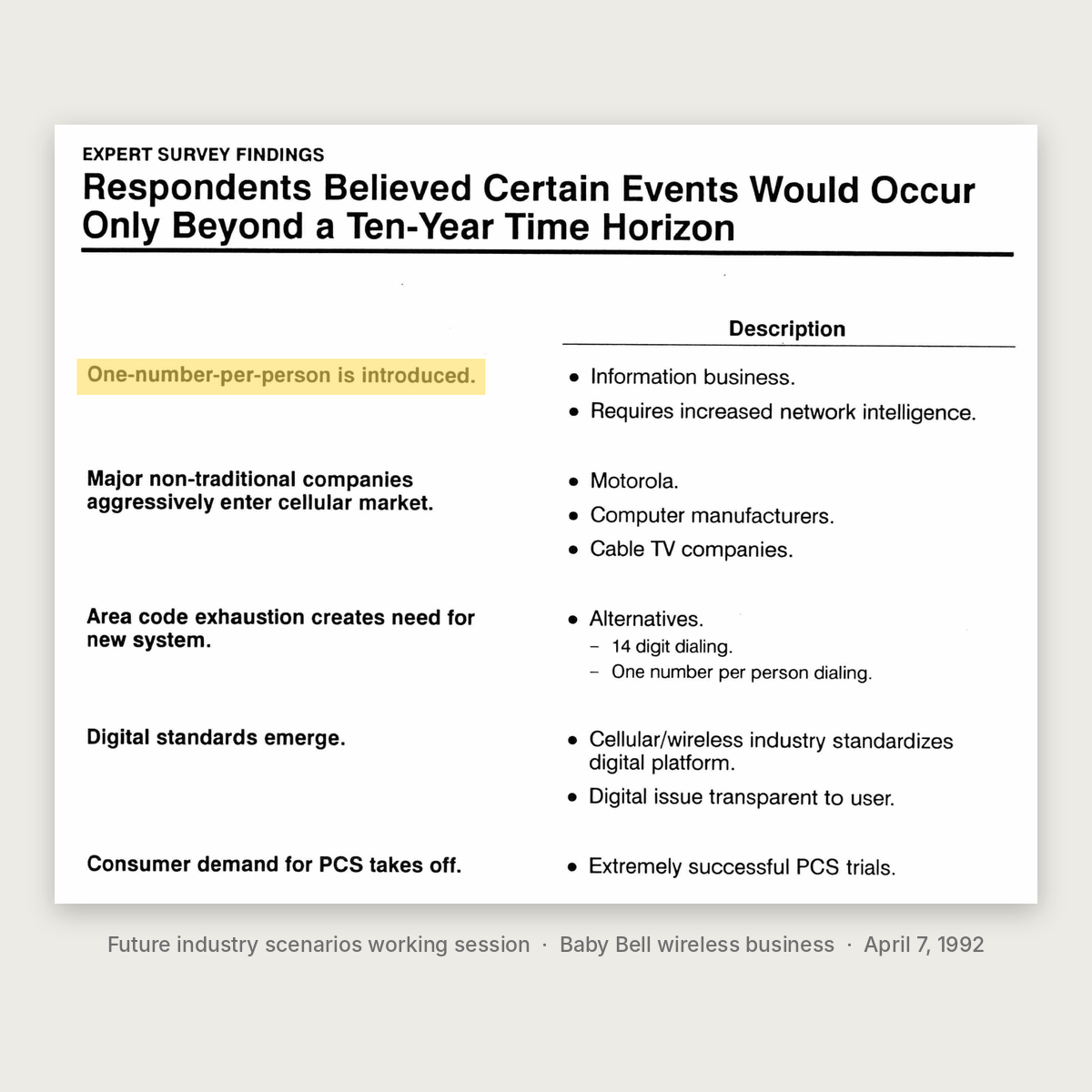
It took eleven years. Wireless number portability came to the US in 2003 and to Canada in 2007.
The methodThe method, not the forecast
The forecast is the easy part to admire. The method behind it is the part worth reusing.
We worked from Peter Schwartz’s The Art of the Long View. It doesn’t ask you to predict the future. It asks you to build a few plausible futures, then choose signposts that tell you which one is arriving. In 1992 we called them milestones, and the closing recommendation was:
Develop a process to monitor ongoing events.
That humility was earned. The word “internet” never appears in the 1992 material. The Mosaic web browser was still a year away. And the industry underestimated itself: in 1991, carriers hoped to reach 15% of Americans by 2000. They reached about 34%.
The forecast matters less than the method behind it.
Two things the 1992 work got right still apply.
The 2026 signposts
If I ran the same exercise on agents today, these are the signposts from the last twelve months I would mark:
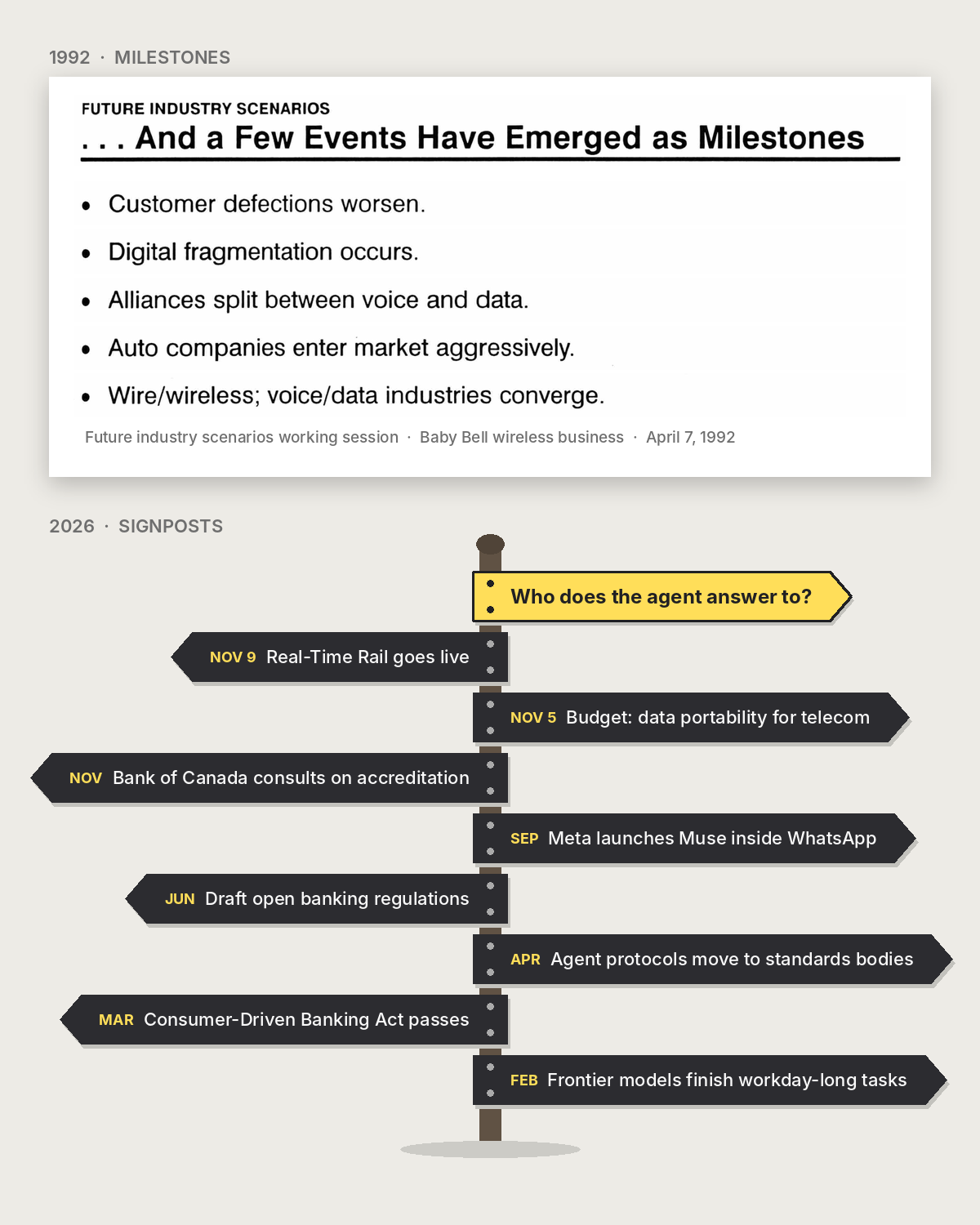
Each is a signpost on its own. Together they point to a world where an agent can see your data, make a decision, and move your money in seconds, with no way to pull it back.
Three scenariosWho does the agent answer to?
Schwartz would ask which uncertainty separates the possible futures. For agents, I think it is this one. Three answers give three scenarios.
These aren’t predictions, and parts of all three will exist at once. The question is which one becomes the default.
What to watchThe signposts to watch
A few events would tell us which way it is going:
- Do the rules say who an agent may represent, and on what terms?
- Do agents check credentials on the other side before payments move, as a matter of course?
- Do they disclose when a recommendation is sponsored?
- Can a customer switch agents and take their history with them, the way we now take our numbers?
The number belonged to the house, then to the car, then to the person. On a party line, you never quite knew who else was listening.
That is the scenario Twinvocate is built for: an agent that answers to the customer, with the mandate, the counterparty check and the receipt in code. Twinvocate is at the prototype stage, and no live payments or real customer data run through it.
I would welcome hearing from others who have done scenario work, in telecom, payments or anywhere else, about the signposts they are watching for agents.
Sources
- RCR Wireless: 15 years ago this month (industry penetration hopes for 2000)
- METR: Time horizons of frontier AI models
- AP via PBS: Meta launches personal AI agent Muse
- Fasken: Draft Consumer-Driven Banking Regulations released
- Bank of Canada: Consultation on draft supervisory guidelines related to accreditation
- Payments Canada: Real-Time Rail
- The Logic: Ottawa extends open banking principles to other sectors